
A group can land at Miami International Airport within minutes of one another and still lose an hour at the curb. One party is waiting for checked bags, another has a different terminal exit, and a third is trying to fit six suitcases into a vehicle built for four passengers. Miami transportation for large groups works best when those details are managed before the first guest arrives.
For executive teams, wedding parties, cruise guests, and families traveling together, the objective is not simply getting everyone from point A to point B. It is protecting the schedule, the comfort of the group, and the quality of the occasion. The right private transportation plan makes the movement feel organized without making guests feel managed.
Start With the Group’s Actual Travel Profile
Headcount is the beginning of the conversation, not the complete answer. A party of 12 executives traveling with carry-ons has very different vehicle needs than 12 cruise passengers with large luggage, garment bags, strollers, or golf clubs. The same is true for a wedding group leaving a hotel with formalwear or a corporate team carrying presentation materials.
Before reserving transportation, confirm the number of passengers, amount and type of luggage, pickup points, final destination, and any required stops. It also helps to identify guests who need extra boarding assistance, child seats, additional privacy, or space for equipment. This allows the vehicle plan to fit the group as it will actually travel, rather than as it looks on a guest list.
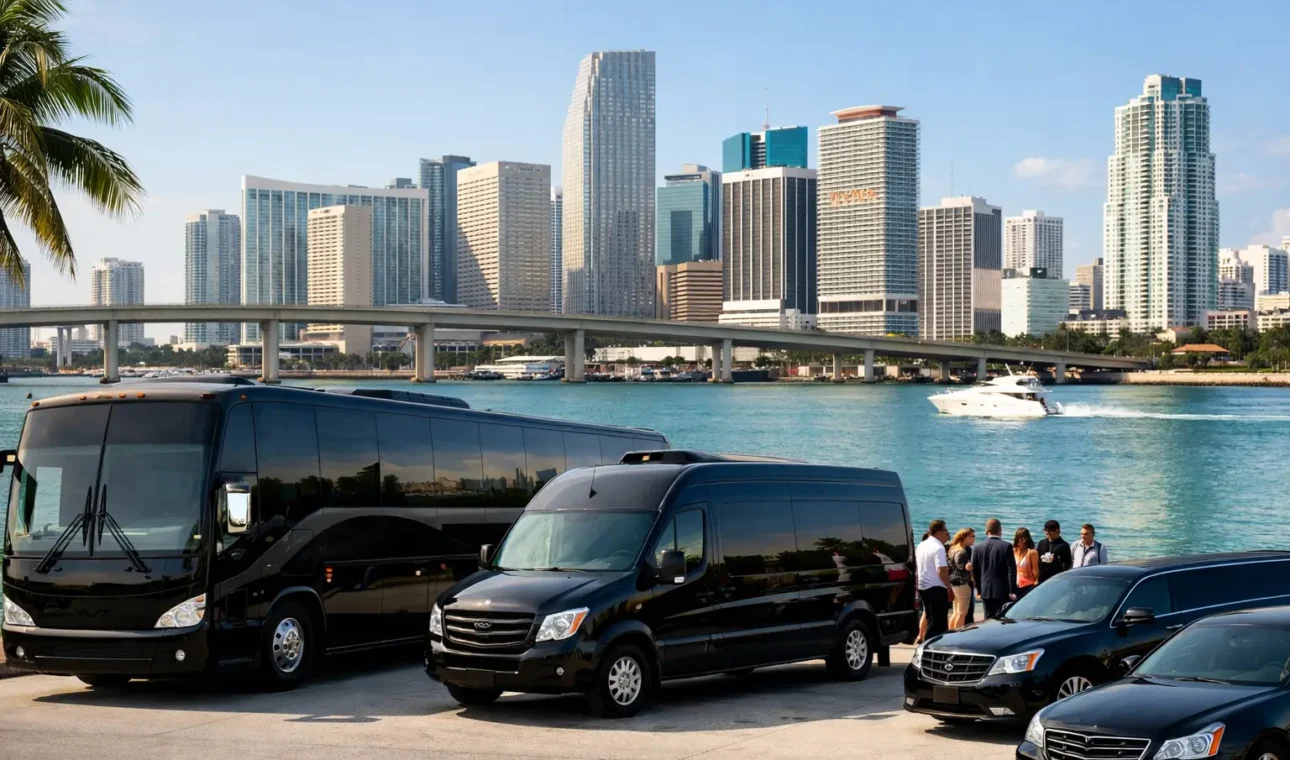
A luxury SUV may be ideal for a small executive party or VIP family, while a Mercedes-Benz Sprinter is often the more practical choice for groups of up to 14 passengers. The trade-off is simple: using fewer vehicles can keep the group together and simplify communication, but it requires careful attention to luggage capacity. In some cases, two coordinated vehicles are the better decision, especially when a group needs more personal space or has a high volume of bags.
Miami Transportation for Large Groups Requires Timing Control
Miami traffic is not static. A transfer that looks straightforward on a map can change quickly around airport terminals, PortMiami, downtown, Brickell, South Beach, the Miami Beach Convention Center, and major sporting or entertainment venues. A dependable plan accounts for the city’s operating conditions rather than relying on best-case travel times.
For airport arrivals, provide every flight number, even when guests are traveling on separate itineraries. Flight monitoring gives the chauffeur team a better view of early arrivals, delays, and gate changes. It also prevents the awkward situation where one part of the group is waiting outside while another is still in the air.
Build a realistic buffer around important moments. For a corporate dinner, that may mean arriving 15 to 20 minutes ahead of the reservation. For a cruise departure, it means planning around terminal access, port traffic, and the ship’s boarding window. For a wedding, it means allowing enough time for photographs, wardrobe adjustments, and guests who are not ready at the exact minute listed on the itinerary.
Hourly chauffeur service is often the strongest option when the schedule includes multiple stops or when the timing may change during the day. A point-to-point transfer is efficient for a direct airport-to-hotel ride. But for roadshows, site visits, shopping appointments, event hopping, or a night out across Miami, an hourly reservation gives the group a vehicle and chauffeur available as plans develop.
Design Arrivals So No One Is Left Guessing
The quality of group transportation is often decided at pickup. Guests should know where to go, who will meet them, and what vehicle to expect. Clear instructions reduce calls, curbside confusion, and the pressure placed on one organizer to coordinate everyone by text.
For airport groups, designate a lead traveler when possible. That person can communicate with the chauffeur after the party has collected luggage and is ready to proceed to the pickup location. For high-profile travelers, private aviation arrivals, or executives who value discretion, the pickup process should be planned with privacy and efficiency in mind.
Hotel departures deserve the same attention. Confirm the correct entrance, bell desk procedures, and whether the vehicle can wait at the front drive. Large hotels may have several towers or pickup areas, and a vague instruction such as “meet us in the lobby” can create unnecessary delay. A precise meeting point makes boarding calmer for guests and easier for staff.
Build the Route Around the Occasion
A transfer is only one part of the guest experience. The itinerary needs to reflect why the group is traveling and what cannot be allowed to go wrong.
Corporate transportation should protect professional timing. If a leadership team is moving between Miami International Airport, a Brickell office, and a client dinner in Miami Beach, the plan should include adequate transfer windows and a vehicle setting that allows travelers to regroup, take calls, or prepare for the next meeting. For conference transportation, it may also require staggered pickups based on individual flight schedules rather than forcing everyone into a single arrival time.
For weddings and private events, the priorities are different. The bridal party may need one vehicle, family members another, and late-night guest transportation after the reception. Keeping these movements separate can feel more polished than trying to place every guest into one large vehicle. It also lets the planner prioritize the people whose arrival time is most critical.
Cruise groups need special attention to luggage and terminal timing. Guests often arrive with more bags than they would for a hotel stay, and PortMiami access can be busy on embarkation days. A vehicle that looks spacious in photos may not be spacious enough once every suitcase is loaded. Confirm capacity honestly at the time of booking.
Choose a Chauffeur Service, Not Just a Vehicle
The vehicle matters, but it is only half of the service. A premium group transfer relies on a professional chauffeur who understands route planning, curbside protocols, guest communication, and the pace of a time-sensitive itinerary.
This is where a reservation-based private service has an advantage over attempting to coordinate multiple rideshares. Rideshare can be useful for a spontaneous solo trip, but it introduces variables that become expensive in time and stress when several guests are involved. Vehicles can arrive at different times, drivers may cancel, luggage may not fit, and the organizer becomes the dispatch center.
A dedicated chauffeur service provides a defined vehicle plan, professional presentation, and a single point of accountability. BlackLine Miami coordinates private group movements with trained chauffeurs, real-time flight and traffic awareness, and luxury SUVs and Sprinter vans selected for executive comfort and luggage needs. For a group organizer, that operational control is often the difference between merely arranging rides and delivering a reliable guest experience.
Give Your Transportation Partner the Right Details
The most successful reservations begin with complete information. Last-minute changes can happen, especially with flights and events, but a strong initial brief gives the transportation team a reliable foundation.
Share the full itinerary, including flight numbers, hotel names, terminal or FBO details, venue addresses, passenger count, luggage estimate, and requested pickup times. Specify whether the group needs a return transfer, multiple vehicles, hourly service, child seats, or stops along the way. If someone else is coordinating on-site, provide that contact as well.
It is also wise to clarify the priorities. Is the goal to keep everyone in one vehicle? Is privacy more important than maximum capacity? Does the group need room to work during the ride? Is there a non-negotiable arrival time? These answers guide the vehicle recommendation and make expectations clear from the start.
Plan for Changes Without Making Them a Crisis
Even the best itinerary can shift. A delayed flight, a meeting that runs long, or a weather interruption can affect the day. The solution is not to overcomplicate every reservation. It is to use a service built to communicate clearly and adjust intelligently when conditions change.
For transfers tied to a fixed departure, such as a cruise boarding time or a private flight, schedule conservatively. For flexible plans, consider hourly service so the chauffeur remains available when a dinner extends or a client adds an unscheduled stop. The right approach depends on how much certainty the group needs and how much flexibility the day demands.
A well-planned ride does more than move people through Miami. It gives every guest a composed beginning, a comfortable place between commitments, and confidence that the next arrival is already under control.